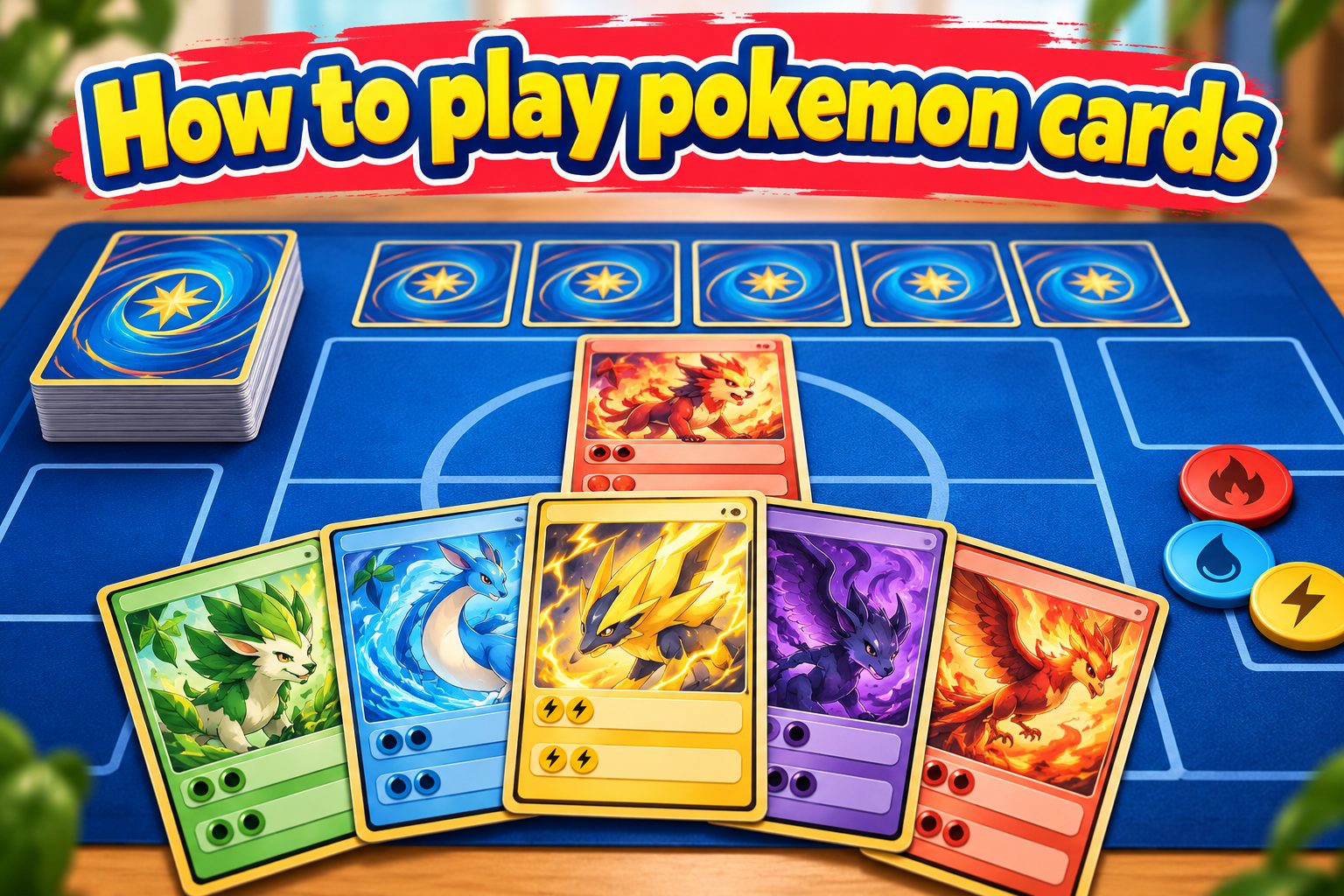
{"intro_paragraphs":["Learning how to play Pokemon cards is easier when you focus on the basic turn order, card types, and goal of the game. The Pokemon Trading Card Game is a strategy game where two players use decks, Pokemon, Energy, and Trainer cards to take Prize cards before their opponent does.","A typical game can feel fast and exciting, but it also rewards careful planning. You decide which Pokemon to place, when to attach Energy, which attacks to use, and how to react when your opponent builds a stronger board.","This guide explains the setup, essential rules, useful strategies, common errors, and practical ways to improve. Whether you are opening your first deck or returning after a break, the key is to learn one decision at a time and keep practicing."],"section_two_paragraphs":["Pokemon cards are designed for a two-player battle. Each player brings a 60-card deck, chooses an Active Pokemon to battle, and places other Basic Pokemon on the Bench as backups. The aim is usually to take all six Prize cards by Knocking Out opposing Pokemon.","Every card has a job. Pokemon attack and may evolve into stronger forms, Energy cards pay attack costs, and Trainer cards provide useful effects such as drawing cards, searching the deck, switching Pokemon, or disrupting the opponent's plan.","The Active Pokemon is the one currently fighting. A Benched Pokemon cannot normally attack, but it can be prepared with Energy or evolved so it is ready to replace the Active Pokemon when needed.","Damage stays on a Pokemon until it is healed or Knocked Out. When damage reaches or exceeds the Pokemon's Hit Points, it is Knocked Out, its attached cards are discarded, and the other player takes the required Prize cards.","Modern Pokemon card games use a clear sequence of turns. Reading the text on cards carefully matters because card effects can change standard rules, but a beginner-friendly deck is the best place to learn the normal flow first."],"section_three":{"h2":"How Do You Play Pokemon Cards Step By Step?","subsections":[{"h3":"Set Up The Play Area","paragraph":"Place your deck in front of you, leave space for a discard pile, and put six Prize cards face down beside the deck. Shuffle well, draw seven cards, and check for a Basic Pokemon. If you do not have one, reveal your hand, shuffle it back, and draw a new hand."},{"h3":"Choose Active And Benched Pokemon","paragraph":"Put one Basic Pokemon face down as your Active Pokemon. You may place additional Basic Pokemon face down on your Bench, up to five total. Once both players are ready, reveal the Pokemon and decide randomly who takes the first turn."},{"h3":"Draw A Card At The Start","paragraph":"At the beginning of each turn, draw one card from your deck. This simple action keeps your options growing, so avoid wasting useful cards too early. If you cannot draw because your deck is empty, you lose the game."},{"h3":"Play Pokemon And Evolve Them","paragraph":"During your turn, you can play Basic Pokemon onto your Bench. You can also evolve a Pokemon by placing the correct evolution card on top, as long as it was in play before the current turn. Evolution often provides more Hit Points and stronger attacks."},{"h3":"Attach One Energy Card","paragraph":"You may attach one Energy card from your hand to one of your Pokemon each turn. Match the Energy symbols in an attack cost whenever possible. Planning Energy attachments ahead of time prevents a powerful Pokemon from sitting unused for several turns."},{"h3":"Use Trainer Cards Carefully","paragraph":"Trainer cards can draw cards, find Pokemon, move Energy, heal damage, or change the board. Item cards are generally flexible, while Supporter cards are limited to one per turn. Read each effect in order and complete as much of it as possible."},{"h3":"Attack And Take Prize Cards","paragraph":"End your turn by attacking with your Active Pokemon if it has enough Energy and no effect prevents it. Apply damage and any listed effects, then check for Knock Outs. When you Knock Out an opposing Pokemon, take the number of Prize cards shown by the rules or card effect."}]},"section_four":{"h2":"What Makes A Strong Pokemon Card Deck?","points":["Start with a clear main attacker so your deck has a consistent plan instead of many unrelated Pokemon.","Include enough Basic Pokemon and search cards to avoid slow starts with no playable Pokemon.","Use Energy counts that support your attacks without filling the deck with cards that do not create options.","Add draw and search Trainer cards so you can find the right Pokemon, Energy, or response when needed.","Test the deck repeatedly and replace cards that are rarely useful with cards that solve a real problem."]},"section_five":{"h2":"Why Playing Pokemon Cards Builds Useful Skills","bullets":[{"label":"Strategic Thinking","text":"Each turn asks you to weigh immediate damage against future setup, which helps players practice planning ahead."},{"label":"Reading Skills","text":"Card text teaches players to follow instructions closely and notice important conditions, costs, and exceptions."},{"label":"Basic Math","text":"Players regularly count damage, Hit Points, Energy costs, Prize cards, and probabilities while playing."},{"label":"Decision Making","text":"A player must choose whether to attack, retreat, evolve, draw cards, or save resources for a later turn."},{"label":"Social Play","text":"Friendly matches encourage clear communication, turn-taking, fair play, and respectful reactions to wins and losses."},{"label":"Patience And Practice","text":"Improvement comes from reviewing games, learning card interactions, and accepting that even strong strategies sometimes fail."]},"section_six":{"h2":"How Can Beginners Improve At Pokemon Cards?","subsections":[{"h3":"Learn With A Ready-To-Play Deck","paragraph":"A prebuilt deck reduces the number of choices before the game begins. It usually includes a straightforward strategy and balanced card counts, allowing you to practice the turn sequence before worrying about deck building or rare cards."},{"h3":"Practice The Opening Turns","paragraph":"The first few turns shape many games, so rehearse setup, choosing an Active Pokemon, filling the Bench, and attaching Energy. Practice alone with two sample hands if needed. Confidence with opening turns makes later decisions less stressful."},{"h3":"Read Cards Before Playing Them","paragraph":"Do not assume two cards with similar names do the same thing. Check attack costs, damage, abilities, weaknesses, retreat costs, and Trainer restrictions. A careful reading prevents illegal plays and often reveals a better option than the obvious one."},{"h3":"Plan One Turn Ahead","paragraph":"Before attacking, ask what your next Active Pokemon will be if the current one is Knocked Out. Also consider where the next Energy should go and which card you need to draw. Simple forward planning makes your board more resilient."},{"h3":"Watch Prize Cards And Win Conditions","paragraph":"It is easy to focus only on damage, but the game is won through Prize cards. Notice how many Prizes each player has left and whether a Knock Out changes the race. Some powerful Pokemon allow opponents to take multiple Prize cards."},{"h3":"Review Games Without Blame","paragraph":"After a match, identify one decision that worked and one that you would change. Perhaps you attached Energy to the wrong Pokemon, used a Supporter too soon, or left an easy target on the Bench. Small reviews create steady improvement."},{"h3":"Play With Clear Communication","paragraph":"Say what you are doing as you play, especially while learning: announce a Trainer card, name an attack, and state damage and effects. Clear communication keeps the match fair, helps both players follow the board, and makes rule questions easier to solve."}]},"conclusion_paragraphs":["Knowing how to play Pokemon cards starts with a few core habits: set up correctly, build your board, attach Energy, use Trainer cards wisely, and attack when the timing is right.","The best learning path is to use a simple deck, play short practice games, and ask questions whenever a card effect is unclear. Every game teaches you more about sequencing and planning.","As you gain confidence, experiment with deck changes and notice how each card supports your overall plan. Strong play is less about owning the rarest cards and more about making thoughtful choices with the cards you have."],"faq":{"h2":"FAQs About Playing Pokemon Cards","items":[{"question":"How many cards are in a Pokemon card deck?","answer":"A standard Pokemon Trading Card Game deck contains 60 cards. Those cards usually include Pokemon, Energy, and Trainer cards. Some casual formats may use different deck sizes, but 60 cards is the normal size for standard competitive-style play and most structured matches."},{"question":"Can you attack on your first turn?","answer":"Under the usual modern rules, the player who goes first cannot attack during their first turn. The player who goes second can normally attack on their first turn if they have a suitable Active Pokemon and enough Energy attached to pay the attack cost."},{"question":"What happens when a Pokemon is Knocked Out?","answer":"When a Pokemon has damage equal to or greater than its Hit Points, it is Knocked Out. Put that Pokemon and its attached cards into the discard pile. The opposing player takes Prize cards according to the Pokemon or applicable game rule, then replaces an Active Pokemon if necessary."},{"question":"Do you need Energy to use every attack?","answer":"Most attacks require Energy, shown by symbols or colorless Energy costs beside the attack name. A few attacks may have no cost, while some effects let Pokemon attack in unusual ways. Always check the exact card text and make sure all required Energy is attached."},{"question":"How many Pokemon can be on the Bench?","answer":"You can normally have up to five Pokemon on your Bench, in addition to one Active Pokemon. Bench space is valuable, so avoid filling it with Pokemon that do not support your plan. Leave room for useful backups, evolving Pokemon, or cards with helpful abilities."},{"question":"What is the easiest way to learn Pokemon cards?","answer":"Start with a beginner-focused, ready-to-play deck and play several relaxed games with someone who can explain the turn order. Focus first on setup, drawing, attaching Energy, and attacking. Once those steps feel natural, add Trainer timing, evolution choices, and deck-building ideas gradually."}]}}
How to Play Pokémon Cards: A Beginner’s Guide